
The MIND LAB Team Won the IEEE CEC 2025 Best Paper Award
Jun 2025

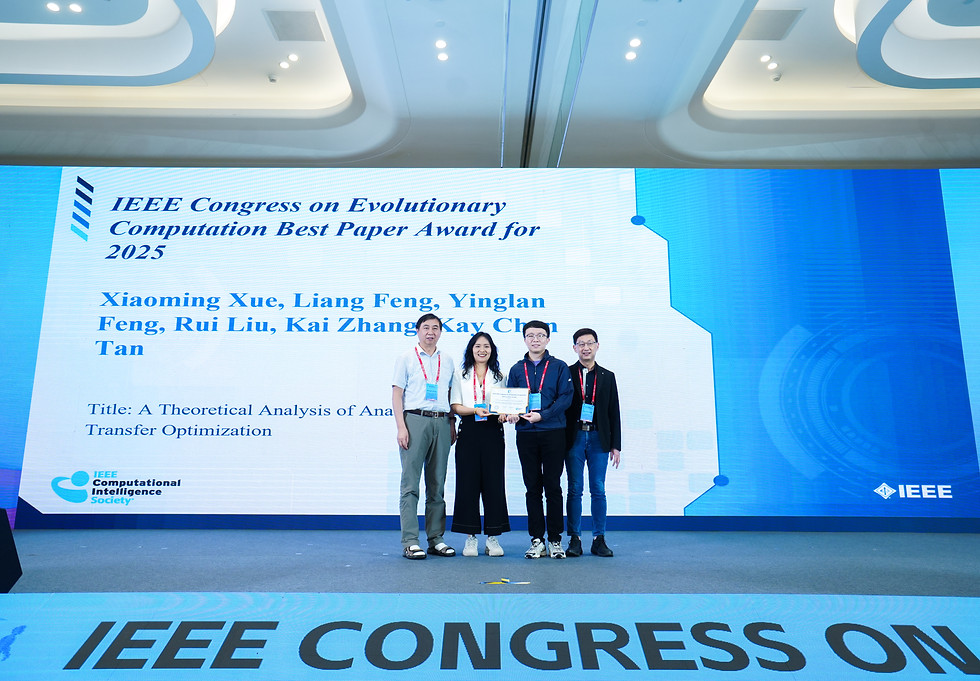
▲Prof. Mengjie Zhang, Dr. Yinglan Feng, Dr. Xiaoming Xue and Prof. Kay Chen Tan (From left to right)
Recently, at the 2025 IEEE Congress on Evolutionary Computation (IEEE CEC 2025) held in Hangzhou, China, the MIND LAB team from The Hong Kong Polytechnic University was awarded the Best Paper Award.
The IEEE CEC is a prominent international conference in the field of evolutionary computation, providing a platform for researchers and practitioners worldwide to share research findings and exchange academic ideas. As one of the three flagship conferences of the IEEE Computational Intelligence Society (IEEE CIS), IEEE CEC began in 1994, initially held as the " IEEE Symposium on Evolutionary Computation" in Orlando, Florida, USA. Over the years, IEEE CEC has grown into a significant event in the evolutionary computation community, attracting scholars from around the globe to explore cutting-edge topics and inspire academic exchanges. Notably, this year's IEEE CEC was hosted independently in China for the first time, drawing participants from 145 countries and regions worldwide. The conference delivered a vibrant and engaging academic feast for all attendees.

The award-winning paper, titled “A Theoretical Analysis of Evolutionary Transfer Optimization”, was authored by Dr. Xiaoming Xue, Dr. Yinglan Feng, Dr. Rui Liu, and Prof. Kay Chen Tan from the MIND LAB, along with Prof. Liang Feng from Chongqing University and Prof. Kai Zhang from Qingdao University of Technology. This study first links the three core subprocesses of analogical reasoning (“retrieval,” “mapping,” and “evaluation”) to the three key issues in knowledge transfer (“what to transfer,” “how to transfer,” and “when to transfer”). Subsequently, focusing on the concept of “similarity” in analogical reasoning, the research establishes theoretical foundations for knowledge transfer methods addressing the three key issues. By constructing composite functions, it systematically analyzes the greatest lower bounds of performance gains in analogy-driven transfer methods, thereby theoretically revealing both the potential and limitations of knowledge transfer. Finally, from the perspective of the “no free lunch theorem,” the study reveals the fundamental distinction between evolutionary transfer optimization (ETO) and traditional evolutionary optimization (EO). ETO introduces a novel perspective for embedding search biases, leveraging task relationship-based knowledge transfer operations that are designed to surpass traditional evolutionary operations, thereby enhancing the performance of EO.
This study is expected to provide researchers with a solid theoretical foundation for understanding the effectiveness of analogy-based ETO while offering a macro perspective to critically examine the advantages and limitations of knowledge transfer. Looking ahead, the MIND LAB team will continue to focus on the theoretical exploration and algorithm design of knowledge transfer in the field of optimization. Their goal is to develop intelligent optimization systems capable of autonomously inheriting and applying experience, effectively addressing diverse optimization challenges arising from problem scale expansion, environmental changes, or shifting demands.
The official website of IEEE CEC 2025: https://www.cec2025.org/
The link to the paper: https://arxiv.org/abs/2503.21156
The full paper: https://arxiv.org/pdf/2503.21156